The enterprise risk operating system, built in Abu Dhabi.
Connect strategy, appetite, indicators, scenarios, controls, evidence and assurance in one live system—so leaders can see exposure, act earlier and prove what changed.
For organisations operating in complex, regulated and operationally critical environments.
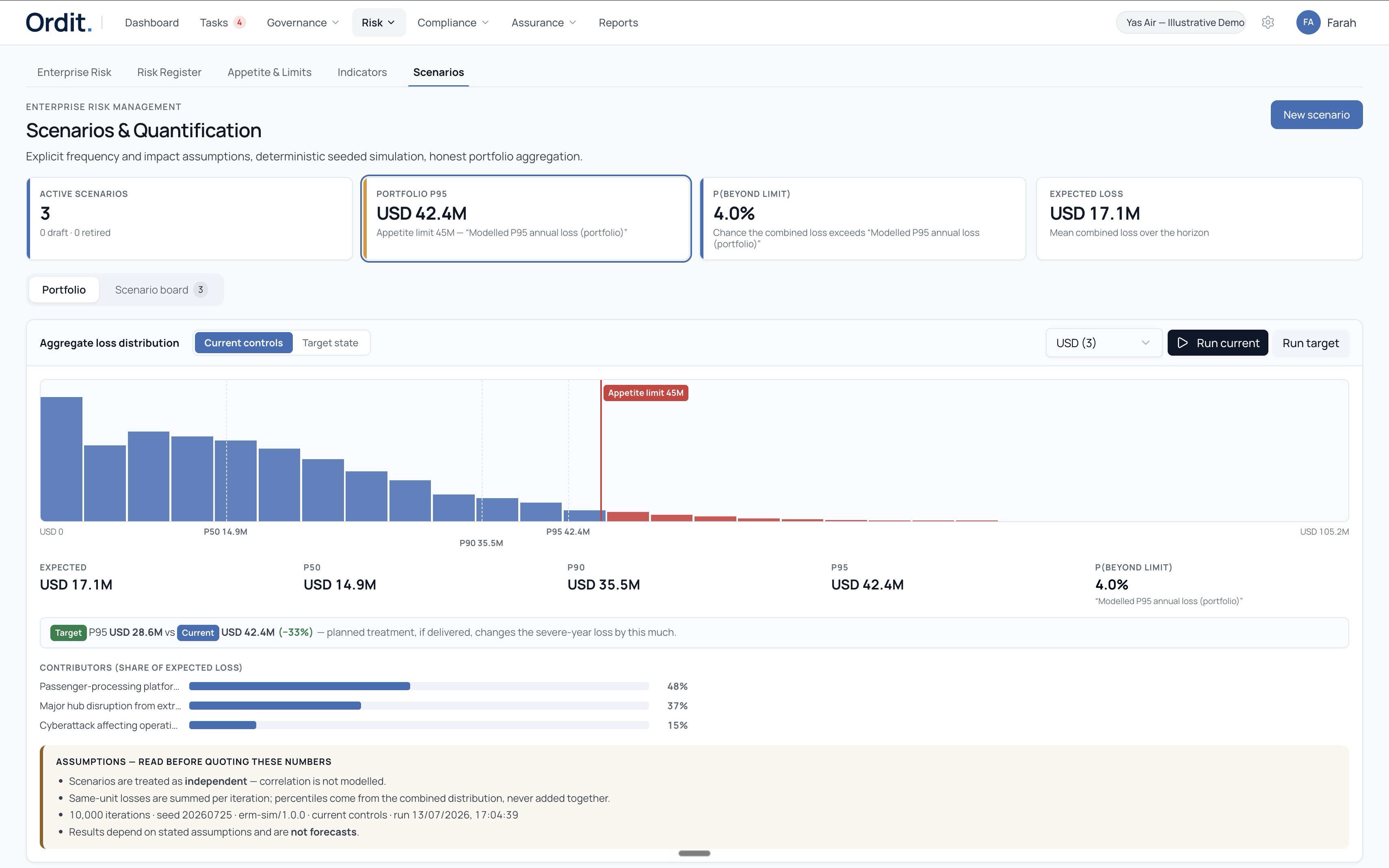
One current view of enterprise risk across the organisation.
Appetite breaches and changing indicators surface before the event.
Decisions, treatments, controls and evidence remain on the record.
Risk is managed in fragments. The enterprise picture is assembled after the fact.
Risks sit in registers. Indicators live in operational dashboards. Controls and evidence sit in compliance systems. Incidents, suppliers and systems are managed elsewhere. The board receives a summary only after teams have manually reconciled the pieces.
Registers without signals
Risks are reviewed periodically, disconnected from the operational indicators that should provide early warning.
Data without context
Incidents, suppliers, systems, AI models and controls exist in separate tools, with no common view of enterprise exposure.
Frameworks without action
Requirements may be mapped and assessed, but ownership, treatment and business decisions remain outside the framework programme.
Reports without traceability
Board packs are reconstructed from spreadsheets and presentations, making it difficult to trace a conclusion back to its assumptions, evidence and actions.
The result is a delayed, partial and difficult-to-defend view of risk.
Risk is the operating model. Controls make it manageable. Governance and assurance make it defensible.
Assess the things that actually create exposure.
Enterprise risk does not live only in a central register. Exposure often starts with a supplier, system, AI model, cloud service, critical asset, incident or control gap. Ordit lets each object carry its own risk context, then connects material exposure back into the enterprise view.
{{ hubBody }}
The register is the index. The real risk lives in systems, suppliers, AI, incidents and controls.
Eight questions the board should be able to ask at any moment.
Ordit is built backwards from these questions. Board reporting is the organising principle—not a report reconstructed at the end.
Every headline figure should trace back to the risk, the decision and the evidence beneath it.
One connected chain, from strategy to board decision.
Strategy and objectives
What the organisation is trying to achieve.
Taxonomy and scope
One enterprise-wide risk classification across entities, functions, locations and services.
Enterprise risk register
Inherent, current and target exposure, with clear ownership.
Appetite and limits
Approved statements, quantitative tolerances and time-bound exceptions.
Indicators
KRIs, KPIs and KCIs, with observations, thresholds, movement and provenance.
Scenarios and quantification
Explicit assumptions and a distribution of possible outcomes.
Treatments and controls
Owned actions intended to move current exposure towards target.
Evidence and assurance
Proof that controls and treatments are operating as intended.
Board decisions
Recorded together with the exposure picture and evidence that supported them.
The board sees what matters now.
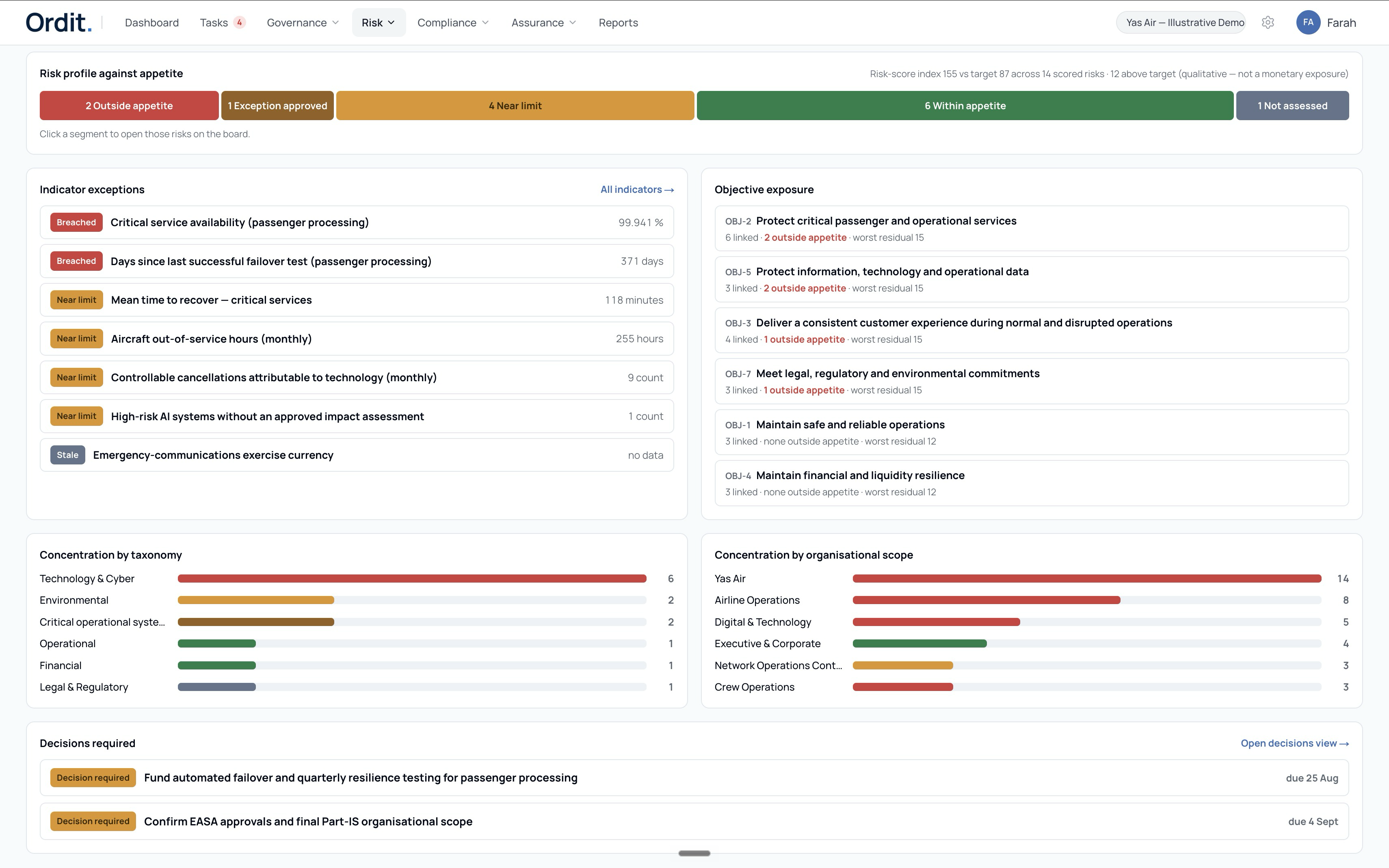
The Enterprise Risk workspace brings appetite, indicators, quantified scenarios, treatments and decisions into one executive view. Leaders can see where exposure sits, what is changing and where action or approval is required.
Exposure states
Keep inherent, current and target exposure visibly distinct.
Appetite
Show whether a risk is within appetite, near a limit, outside appetite or operating under an approved exception.
Early warning
Connect indicator breaches and movement directly to the risks they monitor.
Decisions
Surface treatments, exceptions and investments that require management action.
See where exposure sits, where it needs to be and what must change to close the gap.
Run the enterprise risk process, not only the register.
Quantitative risk
Reproducible Monte Carlo analysis showing expected impact, P50, P90, P95 and the probability of exceeding appetite.
Risk appetite and limits
Turn appetite statements into measurable boundaries, escalation and time-bound exceptions.
Bring risk signals in. Send action back.
Ordit does not require every operational process to move into a new system. It acts as the enterprise risk layer across the tools and organisations already involved in managing risk.
Signals and evidence in
STAGE 01Integration depth varies by platform and is agreed during implementation.
Ordit connects the meaning
STAGE 02Operational data becomes risk context: connected to the exposure, the owner and the decision it should influence.
Action and reporting out
STAGE 03Suppliers
Complete scoped assessments, provide evidence and maintain review information without accessing the wider platform.
Auditors
Receive time-bound, read-only access to the authorised controls, evidence and history.
Advisers and service providers
Collaborate within delegated client scope while the organisation retains ownership and oversight.
Group entities
Maintain local ownership and evidence while reporting through a consolidated enterprise view.
Regulators
Receive authorised views or prepared outputs where the organisation and regulator have agreed the process.
Controls are where risk becomes manageable—and governance makes it accountable.
Ordit connects each material risk to the controls intended to reduce it, the owners accountable for operating those controls, the evidence that supports them and the governance cadence that challenges the result.
Controls linked to risk
See which controls are expected to reduce likelihood, impact or recovery time.
Clear ownership
Assign control owners, review dates and accountability for maintaining the control.
Current control status
Track implementation status, review position, supporting notes and assurance confidence.
Evidence attached once
Keep evidence against the control and reuse it across other applicable control mappings.
Findings become action
Connect audit findings and non-conformities to remediation, ownership and closure.
Statement of Applicability
Record applicability, implementation status, evidence, ownership and justification in one control view.
Roles and accountability
Make ownership gaps visible across risks, controls, policies, systems, suppliers and assurance programmes.
Policies and acknowledgements
Create, review, approve and distribute policies, with named owners and acknowledgement records.
Oversight cadence
Track management reviews, internal audits, policy reviews, attestations and board reporting.
Decisions and approvals
Surface policies under review, exceptions awaiting approval, findings pending verification and risk decisions requiring action.
Control and certification readiness
Keep operational control readiness distinct from the wider gates needed for certification or formal assurance.
Nothing is silently rewritten.
Every change to a risk, control, decision or piece of evidence is recorded as an immutable event—who, what, when and why—so the history behind any conclusion can be replayed for an auditor, a regulator or the board.
Risk tells you what matters. Controls show what protects it. Governance proves who is accountable.
One control. Many obligations. One evidence trail.
Ordit connects standards, regulatory requirements and internal policies to a common control model. Evidence, testing, findings and actions remain attached to the control, allowing teams to reuse the work without losing ownership, context or assurance history.
Requirements and obligations
Overlapping standards, regulations and policies are mapped once to a shared control set.
Common controls
One tested control can satisfy several requirements, with clear ownership and review dates.
Evidence and testing
Evidence is attached once and reused across every mapped requirement, without duplicating the file.
Assurance and reporting
Findings, corrective actions and assurance history produce the view each audience needs.
Framework and regulatory overlays are configured to the organisation's scope, jurisdictions and assurance requirements—from ISO 27001 and ISO 42001 (AI) to internal policy sets.
What makes an AI system risky?
The answer is not determined by the model alone. Risk depends on the purpose, the decisions supported, the people affected, the data used, the degree of autonomy, the suppliers involved and how the system is monitored over time.
{{ aiBody }}
Ordit supports classification and structures applicability and impact assessment. It does not determine legal classification or compliance automatically.
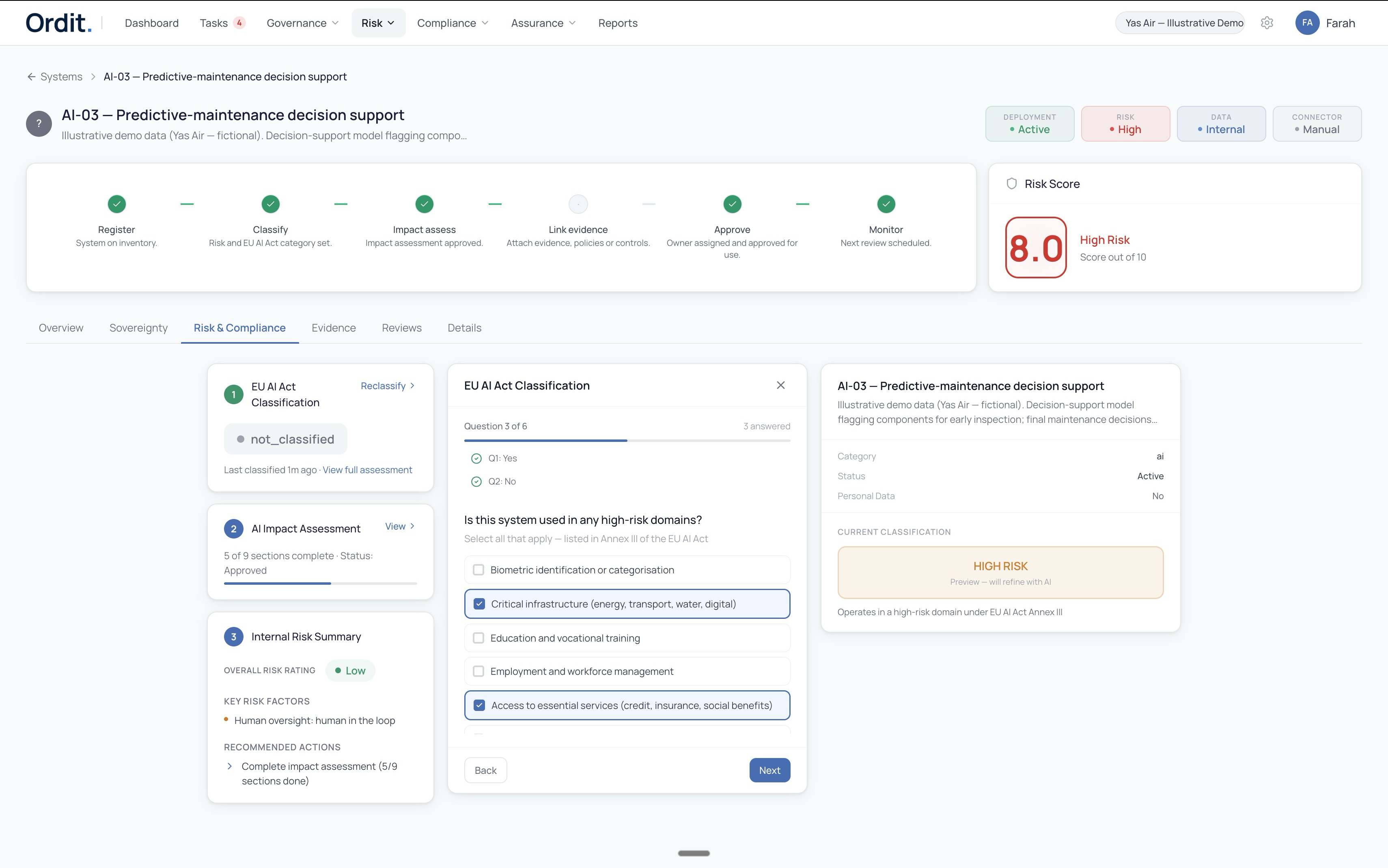
Every AI system becomes a governed risk object—not an untracked experiment.
Depth where enterprise risk usually runs out.
ERM is the operating model
Appetite, indicators, scenarios and decisions are core records—not a reporting layer bolted onto a compliance tool.
Governance and controls beneath it
Ownership, policies, control assurance, findings and evidence carry the work needed to actually change exposure.
Connected, not replacing
Controlled integrations and scoped external workflows let suppliers, auditors, advisers and group entities take part without moving everything into one tool.
Built for scrutiny in the region
A single-tenant, UAE-hosted deployment model and an immutable event history designed for organisations that must defend their answer.
Built for organisations where failure is consequential.
Ordit is designed for regulated entities, multi-entity groups and operationally critical organisations—where risk must be defensible to a regulator, an auditor and a board in the same week.
Banking and financial services
Regulatory workflows, control assurance and quantified operational risk in one defensible record.
Government and public sector
Entity-level scope, sovereignty requirements and consolidated reporting across bodies.
Critical infrastructure and operations
Asset, supplier, continuity and incident exposure connected to enterprise risk and appetite.
Multi-entity groups and advisers
One taxonomy across subsidiaries, with delegated ownership and group aggregation.
One client. One ring-fenced AWS environment. Hosted in the UAE.
Every Ordit customer is deployed into a separate cloud environment in the UAE. The application, data and evidence remain within the agreed customer boundary, with encryption, access controls and integration governance designed for organisations operating under scrutiny.
A separate environment per customer
Each customer is deployed into their own ring-fenced AWS environment in the UAE. The application, database, evidence, logs and backups remain within the agreed hosting boundary.
Encrypted in transit and at rest
Traffic is encrypted in transit using TLS. Stored data is encrypted at rest using AWS-native database and storage encryption controls.
Controlled access and integrations
Least-privilege access, enterprise identity and role-based permissions—with external connections explicitly configured and governed under the approved architecture.
The exact infrastructure and security boundary is documented during implementation. AWS is referenced as the hosting provider only; no endorsement or certification is implied.
One client. One ring-fenced UAE environment.
Built in Abu Dhabi, for complex and regulated organisations.
We build Ordit with risk, audit and assurance practitioners in the region we operate in. The product reflects how enterprise risk is actually run: contested assumptions, real ownership, regulatory scrutiny and boards that need a defensible answer now.
See exposure. Act earlier. Prove what changed.
Talk to us: hello@ordit.ai
Start with the risks that matter most.
Working session
We walk your top enterprise risks, appetite statements and current reporting cycle.
Scope and architecture
Entities, taxonomy, roles, integrations, hosting boundary and security requirements are agreed and documented.
First board cycle
A defined set of risks, indicators and controls goes live and produces a real board view.
From there, suppliers, systems, AI governance, frameworks and assurance programmes are added as the operating rhythm settles.
What enterprise buyers ask us.
Ordit is an enterprise risk operating system with unusually deep governance, risk, compliance and assurance capabilities. Enterprise risk is the centre of gravity; governance, controls, evidence, compliance and audit provide the operating spine that makes the risk position actionable and defensible.
Ordit can replace fragmented risk registers, control trackers, evidence repositories, framework spreadsheets and manual board-pack assembly. Specialist operational platforms can remain in place as systems of execution, while Ordit becomes the enterprise system of record and decision layer for the material risks, signals, controls, treatments and evidence they produce.
Ordit connects a common risk taxonomy, organisational hierarchy, ownership model and risk appetite framework across the group. It then links enterprise risks to indicators, scenarios, systems, suppliers, AI systems, incidents, controls, evidence and actions—giving leaders one cockpit showing what is outside appetite, what is changing and which decisions are required.
Yes. Ordit supports controlled integrations, APIs, webhooks, data imports and connectors so operational metrics, incidents, tasks, evidence, system data and supplier information can feed the enterprise risk picture. Ordit can also send actions, alerts and workflow updates back to approved enterprise tools, with the integration scope agreed during implementation.
Controls can be linked to the risks they mitigate and to multiple standards, regulations and internal policies. Evidence, testing, findings and corrective actions remain attached to the control, allowing the organisation to reuse the work across frameworks without duplicating files or losing traceability.
Yes. A group can maintain one enterprise taxonomy and consolidated risk view while allowing individual entities, functions and jurisdictions to retain local ownership, obligations and reporting cadences. Suppliers can complete scoped assessments, auditors can review authorised evidence, and advisers or service providers can collaborate within delegated client scope.
Every AI system becomes a governed risk object with a named owner, defined purpose, classification, applicability assessment, impact and risk assessment, human oversight, controls, evidence, indicators, incidents and review cadence. This supports ISO/IEC 42001, EU AI Act readiness and internal AI governance without pretending that software makes the final legal or risk decision.
Authorised users can update the current record, but material changes are appended to Ordit’s immutable event history rather than silently overwriting what came before. Decisions, approvals, exceptions, evidence links and historical states remain traceable to the person and timestamp that created them.
Each customer receives a separate, ring-fenced Ordit environment hosted on AWS in the UAE, with distinct application, database, evidence, storage, logging and backup boundaries. Data is encrypted in transit using TLS and encrypted at rest using AWS-native encryption controls, with role-based access and controlled integrations configured to the agreed customer architecture.
Certification is granted by an accredited certification body, and formal regulatory filings remain the organisation’s responsibility. Ordit supports the complete operating process by mapping requirements, maintaining evidence, surfacing findings, tracking corrective action, managing reporting cadence and preparing authorised outputs for the approved external channel.
Most organisations begin with a decision-critical slice: priority enterprise risks, appetite limits, selected indicators, two or three scenarios, the supporting controls and evidence, and the first executive or board view. Once that operating model is proven, Ordit can expand across additional entities, functions, systems, suppliers, AI use cases, frameworks and regulatory workflows.
See your enterprise risk picture in one live system.
A 45-minute walkthrough with our team: your risks, your appetite, your indicators and the board view they produce.